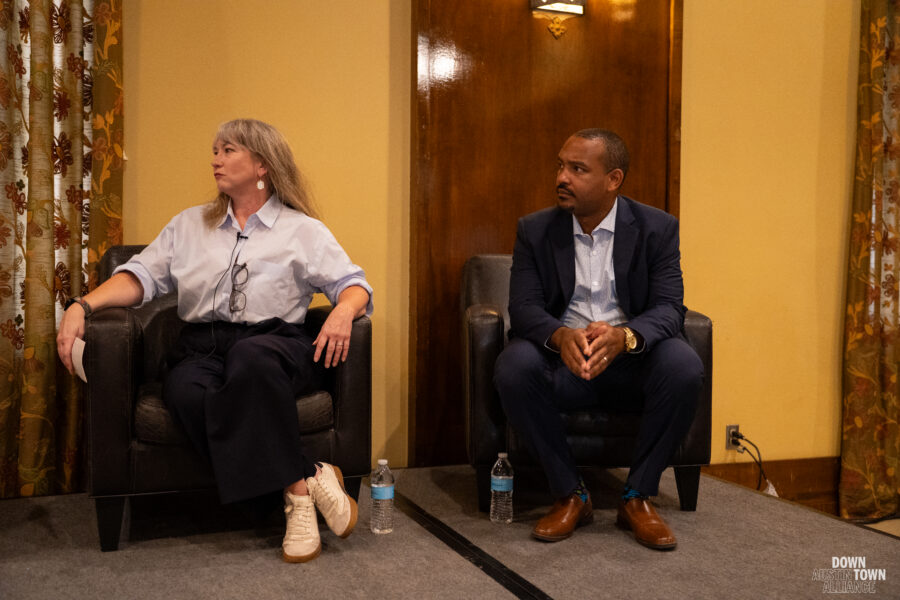
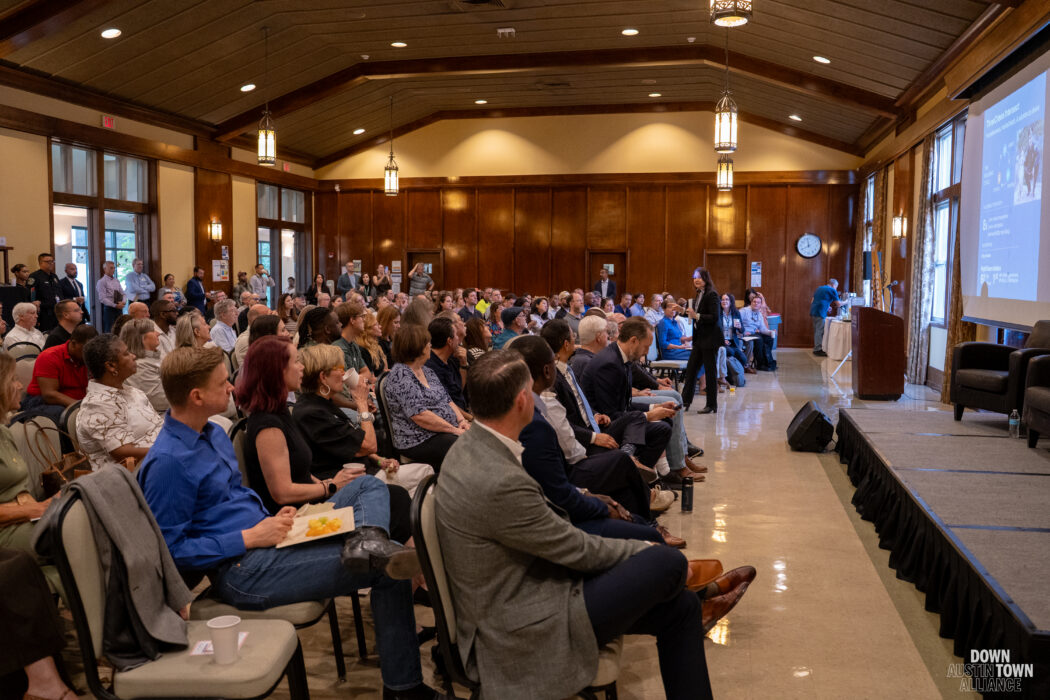
On Tuesday, September 15, the Downtown Austin Alliance hosted a special installment of their educational event series, Issues & Eggs. This event focused on the No Wrong Door initiative and city and county efforts to better address the needs of our community’s highest system utilizers. No Wrong Door (NWD) is a coordinated, multi-agency effort involving 17 local and regional partners, including APD, EMS, Central Health, Integral Care and the Downtown Austin Alliance, to connect the roughly 950 “high utilizers” in Travis County (people cycling repeatedly through jail, hospitals and homelessness) with crisis care, step-down care, sustained housing, healthcare and behavioral health services, rather than the revolving-door, quick-fix emergency response that currently costs taxpayers around $137 million annually without solving the problem. Since April 2026, the program has secured a signed MOU among partners, committed county/city funding toward a joint mental health crisis care center, and driven state-level legislative advocacy.
Setting the Stage: A Presentation from APD
The Issues & Eggs – No Wrong Door: Breaking the Homelessness & Mental Health Cycle event featured a presentation from Maris Herold, Chief of Strategic Initiatives with the Austin Police Department (APD), where she shared how the No Wrong Door program was influenced by her previous police work in Boulder, Colorado. Boulder pioneered a similar high-utilizer coordination model, becoming the first city in the country to secure consent-driven data-sharing agreements across agencies to better serve the high-utilizer population.
Chief Herold described how the NWD pilot is currently operating. So far, APD has engaged 99 high utilizers identified through the program. Since the initiative began, that group has had over 300 fewer calls to APD —a 31% reduction overall and a 57% reduction among the highest-risk individuals.
Chief Herold described the cycle these individuals are trapped in: they are arrested, taken to a hospital and then they are back on the streets. With no wraparound care or follow-up support to help them find lasting stability. Without a coordinated system, law enforcement is left as the default responder to a mental health crisis, pulling officers away from other public safety needs, perpetuating the cycle.
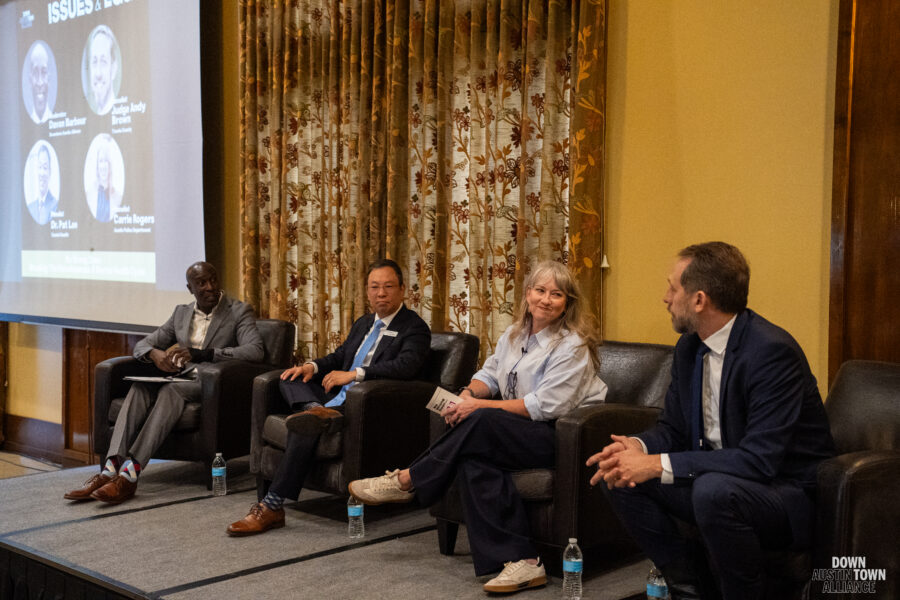
A Panel of Perspectives
After Chief Herold’s presentation, Downtown Austin Alliance President & CEO Davon Barbour moderated a panel of experts:
- Dr. Pat Lee, President & CEO of Central Health
- Carrie Rogers, Government Relations Officer for the City of Austin
- Travis County Judge Andy Brown
Each panelist shared their perspective and the projects their organizations are leading that contribute to No Wrong Door and other mental health and homelessness causes.
Carrie Rogers spoke to the state advocacy side of this work, framing No Wrong Door as an endeavor that requires the city, county and state to function as one coordinated system rather than three disconnected ones. She shared the scope of the problem in numbers: an estimated 950 high utilizers across Travis County, and roughly $137 million spent annually managing this population through the current fragmented system of jails, ERs and law enforcement without helping the people stuck in the cycle or solving the underlying problem. Rogers outlined the specific policy changes needed to move the needle, including expanding crisis bed capacity, building out step-down residential care and broadening emergency detention authority beyond peace officers to include trained clinicians. She also noted that Austin isn’t alone in facing this challenge; multiple cities across Texas are grappling with the same gaps in care, and pointed to the City’s ongoing legislative advocacy, including testimony before state committees and a letter from Mayor Watson to the Sunset Advisory Commission, as the path toward securing the state-level support needed to close those gaps.
Dr. Pat Lee brought the healthcare and cost-of-inaction perspective to the conversation, highlighting Salt Lake City’s mental health crisis continuum as a model for what a more comprehensive system could look like in Central Texas. He lifted up Integral Care’s respite program as an example of what’s already working locally and what should be built upon. He made the economic case for investment, arguing that a more coordinated system doesn’t just improve outcomes for patients, it reduces long-term costs for taxpayers. Dr. Lee also spoke candidly about the trust-building required to reach this population, noting that many high utilizers don’t recognize they need help, so earning their trust is often the first and hardest step toward getting them into sustained care. He pointed to the lack of “step-down” residential capacity, the bridge between an acute crisis and independent living, as one of the most significant gaps in Austin’s continuum of care today and one that Central Health cannot close on its own without state support.
While not specifically involved with the No Wrong Door coalition, Travis County Judge Andy Brown shared the importance of and progress in building the county’s Mental Health Diversion Center, describing the advancement of the mental health diversion pilot and Phase One design of the center. The judge spoke to the funding gaps threatening the county’s broader efforts, including a $4.6 million shortfall for FY27 in support services needed to sustain the county’s Supportive Housing Initiative Partnership (SHIP) program even after securing housing units and rental vouchers, the other two “legs” of permanent supportive housing. Judge Brown argued that closing that gap, along with clarifying where county responsibility ends and state responsibility begins, will be essential to making mental health diversion a lasting reality.
We even had a surprise appearance from David Gray, Director of the City of Austin’s Homeless Strategy Office, who joined the panel discussion to share the office’s role in this work. Gray emphasized that Austin’s response cannot rest on enforcement alone; it has to lead with outreach and connect people to services first. He stressed that no single department or organization can tackle homelessness and behavioral health alone. Gray pointed to HSO’s Downtown Homelessness Task Force with the Downtown Austin Alliance as a clear example of that shared responsibility in action — a cross-agency effort to reduce homelessness downtown by curbing the influx of newly unhoused individuals and increasing the number of people transitioning off the streets into shelter, housing or diversion programs. His message echoed the morning’s theme: real progress on this issue happens only when the City, County, healthcare partners, law enforcement and organizations like DAA pull in the same direction.
Each panelist’s work ties directly back to the Downtown Austin Alliance’s homelessness position points, a set of policy priorities the DAA board recently adopted in support of coordinated, community-driven solutions to homelessness and behavioral health challenges downtown.
A Testament to What Collaboration Can Do
No Wrong Door will be a testament to what happens when organizations come together: solutions. From a police chief rethinking crisis response to a healthcare system investing in respite and step-down care, to a county building the infrastructure for diversion, to a city carrying the case to the State Capitol, this is what coordinated action looks like. The Downtown Austin Alliance remains committed to supporting the policy and funding solutions needed to bring lasting change to downtown, the city, the county and the broader Central Texas region.